
Understanding the Dubai Property Visa
Buying property in Dubai can open the door to something more valuable than just owning real estate. It can get you a residence visa. Think of it like getting a membership card to live in one of the world’s most dynamic cities, except this membership comes from investing in bricks and mortar.
The Dubai property visa is a residency option offered to investors who purchase approved real estate in the UAE.
Here’s how it works in simple terms. When you buy property in Dubai that meets certain government requirements, you become eligible to apply for a residence visa. This isn’t just a tourist pass. It’s a proper residency permit that allows you to live in the UAE, work if you want to, and manage all your personal affairs without restrictions. You can open bank accounts. Get a local phone number. Register your kids in school. All the things that come with actually living somewhere, not just visiting.
The best part? You don’t need to set up a company or find an employer to sponsor you. The property itself becomes your pathway to residency. It’s like the real estate is vouching for you, telling the government you’re serious about being part of Dubai’s future.
This system exists because Dubai wants to attract Investors and high-quality residents. The city has positioned itself as a global hub for business, tourism, and luxury living. By offering residency through property ownership, Dubai makes it easier for people to commit long-term. And when people commit long-term, they spend money, start businesses, and contribute to the economy. Everyone wins.
Do You Get a Visa If You Buy Property in Dubai?
Yes. Buyers can get a Dubai property investor visa, depending on the value and type of Property they purchase. Off-plan units can qualify only after handover.
But there are rules. Not every property purchase automatically qualifies you for a visa. The government has set specific thresholds to make sure investors are making substantial contributions to the real estate market.
First, the property must be worth AED 750,000 or above. That’s roughly $204,000 at current exchange rates. This is the minimum ticket to entry for the basic investor visa. Anything below that won’t qualify, no matter how nice the apartment is or how good the location.
Second, ownership must be under the applicant’s name. If you’re buying the property for someone else, or if it’s registered under a company that you don’t directly own, things get complicated. The title deed needs to show your name clearly. Joint ownership is possible, but only under specific conditions we’ll cover later.
Third, here’s something important that trips up many buyers: a mortgage is allowed if 50% equity is paid. You don’t need to pay cash for the entire property. Banks in Dubai offer mortgages to residents and non-residents alike. As long as you’ve put down at least half the property value from your own pocket, the mortgaged portion still counts toward the visa requirement. It’s like the government is saying, “We care that you’re invested, but we understand leverage.”
One critical point many people miss: off-plan properties don’t count until completion. You might buy a unit in a shiny new tower that’s still under construction. That’s fine for investment purposes. But you can’t apply for your property visa until the developer hands over the keys, and you get your title deed. Think of it like ordering a car. You don’t get the driver’s license benefits until the car is actually delivered and registered in your name.
Types of Dubai Property Visas for Investors
Dubai offers different visa categories based on how much you invest and what your long-term plans are. It’s like choosing between different gym memberships. Each tier gives you different benefits and commitment periods.
1. 2-Year Dubai Property Investor Visa
Minimum property value: AED 750,000
This is the entry-level option, but don’t let that fool you into thinking it’s not valuable. A two-year residency visa is substantial, especially compared to the constant visa runs some expats have to make in other countries.
Single owner or joint ownership (spouse allowed). If you’re married, you and your spouse can co-own the property and both qualify for the visa. But it only works for legal spouses, not business partners or family members. You’ll need to provide a marriage certificate to prove the relationship.
Renewable every two years. As long as you still own the property when the visa expires, you can renew it. The renewal process is straightforward, though you’ll need to go through medical tests and documentation again. Think of it like renewing your car registration. A bit of paperwork, but nothing dramatic.
The two-year visa is perfect for people who want to test the waters. Maybe you’re not sure if Dubai is your forever home, but you want the option to stay without visa hassles. Or perhaps you’re buying property as an investment, and the visa is a nice bonus. Either way, this tier gives you flexibility without requiring a massive investment.
2. 10-Year Golden Visa Through Property Investment
Minimum property value: AED 2 million
Now we’re talking about serious commitment. The Golden Visa is Dubai’s way of rolling out the red carpet for substantial investors. AED 2 million is about $545,000, which puts you in the range of luxury apartments or nice villas in good neighbourhoods.
Can include mortgaged property. Just like the two-year visa, you can use a mortgage here. The difference is that the total value needs to hit that AED 2 million mark. So if you put down AED 1 million and mortgage another AED 1 million, you’re good to go.
Long-term stability for investors and families. Ten years is a long time. It’s enough to see your kids through school. Build a business from scratch. Really put down roots. The Golden Visa removes the uncertainty that comes with shorter residency permits. You’re not constantly thinking about renewal dates or whether your circumstances might change and force you to leave.
This visa category has become incredibly popular with high-net-worth individuals. They see it as buying stability in an increasingly uncertain world. Dubai offers zero income tax, excellent infrastructure, safety, and a cosmopolitan lifestyle. The Golden Visa locks all of that in for a decade.
One more thing: the Golden Visa isn’t just about you. It covers your whole family. Spouse, children, and even parents in some cases. Everyone gets the same long-term security. It’s like buying peace of mind wholesale.
3. 5-Year Retirement Visa Through Property
Minimum investment: AED 1 million
Age requirement: 55+
Valid for retirees owning property in Dubai
Dubai isn’t just for young professionals and entrepreneurs. The city wants retirees, too, and this visa proves it. If you’re 55 or older and you buy property worth at least AED 1 million, you can get a five-year retirement visa.
Think about what this means. You spend your career working hard, saving money, and dreaming about retirement. Now you can retire somewhere with sunshine 300 days a year, world-class healthcare, zero income tax, and a thriving expat community. The property investment gives you the right to be there long-term.
This visa is renewable as long as you maintain ownership of the property. So theoretically, you could spend your entire retirement in Dubai, renewing every five years. Many retirees find this attractive because Dubai combines first-world amenities with lower living costs than places like London or New York. Your retirement savings go further while your quality of life stays high.
Eligibility Criteria for Dubai Property Visa
Meeting the investment threshold is just the starting point. The government has several other requirements you need to tick off before your visa gets approved. Here’s what they’re looking for:
Property value meets the minimum threshold. We’ve covered this already, but it bears repeating because it’s the foundation of everything. AED 750,000 for two years, AED 2 million for Golden Visa, or AED 1 million if you’re a retiree.
Unit must be completed and ready for handover. No off-plan properties, no matter how close to completion. The building needs to be done, inspected, and approved. You need to have actual keys in hand.
Ownership documented in the title deed (Oqood not accepted). This trips up people sometimes. In Dubai, there are different property documents. The Oqood is a preliminary registration document used during construction. It proves you’ve bought something, but it’s not the final ownership certificate. For visa purposes, you need the actual title deed from the Dubai Land Department. That’s the gold standard document that proves you own the property free and clear.
Applicant must pass background and health checks. Standard procedure for any visa. They’ll screen your criminal record and make sure you don’t have any communicable diseases. If you’re a law-abiding citizen in good health, this shouldn’t be an obstacle.
Joint ownership is allowed only for spouses (with a marriage certificate). We mentioned this earlier, but it’s important enough to repeat. You can’t split the investment with a friend or business partner, and both get visas. It only works for married couples, and you’ll need to prove the marriage is legal.
Think of these criteria as quality control measures. Dubai wants investors who are serious and legitimate. They’re not trying to make the process impossible, just organised and professional.
Step-by-Step Process to Apply for a Property Visa in Dubai
Getting your property visa isn’t rocket science, but there is a specific sequence to follow. Here’s how it works from start to finish:
Buy a completed property that meets the visa requirements. This is step one, obviously. Work with a real estate agent, find a property you like, negotiate the price, and close the deal. Make sure the property value meets your visa goal before you sign anything.
Obtain the Title Deed from the Dubai Land Department. After you complete the purchase, the developer or seller will facilitate the transfer of the title deed. This happens at the Dubai Land Department, which is the government agency responsible for all property registrations. You’ll pay a transfer fee (usually 4% of the property value) and some administrative charges. Then you get your title deed.
Apply for a property visa through the Dubai Land Department offices. Once you have the title deed in hand, you can start the visa application. The Dubai Land Department has streamlined this process significantly in recent years. You can do much of it online, though you’ll still need to visit their offices for certain steps.
Undergo medical test and Emirates ID processing. The government requires a health screening. You’ll visit an approved medical centre for blood tests and a chest X-ray. Nothing invasive, just basic health checks. At the same time, you’ll apply for your Emirates ID, which is the national identification card everyone in the UAE needs to have.
Complete biometric verification. They’ll take your fingerprints and photograph. This gets stored in the government database and linked to your visa and Emirates ID.
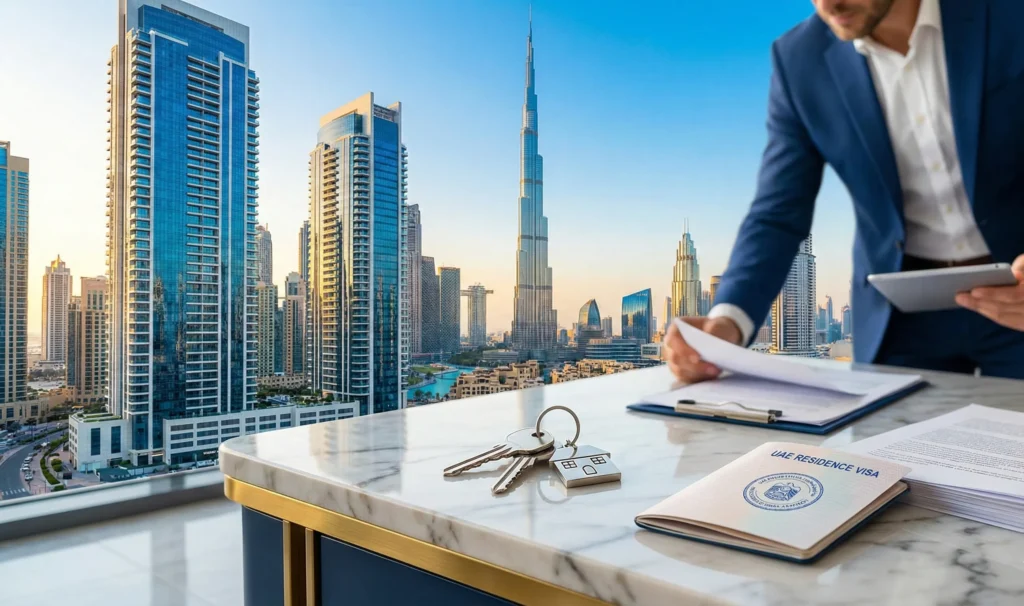
Receive a residence visa stamp. The final step is getting your visa stamped in your passport. This is the physical proof that you’re a UAE resident. Congratulations, you’re done.
The entire process can be completed in a few days if all documents are ready. That’s not an exaggeration. If you’ve got everything organised, Dubai’s government systems are efficient enough to process your visa quickly. Some people get it done in less than a week. Others take longer if they’re missing documents or hit administrative snags, but the system is designed for speed.
Required Documents for Property Visa Application
Let’s talk paperwork. You’ll need to gather these documents before you start the application process. Having everything ready upfront will save you time and headaches.
Original passport. Not a copy. The actual passport. Make sure it’s valid for at least six months. If your passport is expiring soon, renew it first.
Title deed. This is your proof of property ownership. It’s the most important document in the entire application. Make sure it’s the final registered title deed, not a preliminary document.
Property valuation certificate (if needed). Sometimes the government wants confirmation of the property’s current market value. This is especially true if you bought the property a while ago or if there’s any question about whether it meets the minimum threshold. A certified valuer can provide this.
Recent passport photos. Standard passport-sized photos with a white background. Nothing fancy. Most typing centres near government offices can take these for you if you didn’t bring any.
Health insurance. UAE law requires all residents to have health insurance. You’ll need proof of coverage before your visa gets approved. Many property developers actually offer health insurance packages as part of the purchase deal.
Marriage certificate (for joint ownership). If you and your spouse are co-owning the property and both applying for visas, you’ll need to prove you’re legally married. The certificate needs to be attested and translated if it’s not in Arabic or English.
Keep copies of everything. Digital and physical. Government offices sometimes misplace documents, and having backups will save you from starting over.
Benefits of Getting a Dubai Property Visa
Why go through all this trouble? What do you actually get from having a Dubai property visa? Let’s break down the practical benefits:
Live legally in the UAE. This is the obvious one. You can stay in Dubai without worrying about tourist visa limits or visa runs. You’re a resident, not a visitor.
Sponsor your spouse and children. Once you have your own residency visa, you can sponsor your family members. They get residence visas too, linked to yours. Your kids can go to school, and your spouse can work if they want to. Everyone gets the same benefits.
Open bank accounts. Banks in Dubai require residency for opening local accounts. As a tourist, your options are limited. But with a residence visa, you can open current accounts, savings accounts, and get credit cards. This makes managing money in Dubai infinitely easier.
Apply for a driving license. Dubai’s public transport is improving, but let’s be honest. It’s a car city. Having a local driving license makes life much more convenient. You can’t get a UAE license without residency.
Access world-class business and lifestyle opportunities. Being a resident opens doors that tourists never see. You can start a business more easily. Join clubs and associations. Send your kids to better schools. Basically, you become part of the community instead of just passing through.
Long-term investment security. Here’s something people don’t always consider. Property ownership combined with residency creates a virtuous cycle. You’re more invested in Dubai’s success. You pay attention to the market. You maintain your property better. You become a stakeholder in the city’s future. That psychological shift matters.
Plus, there’s the tax angle. Dubai has zero personal income tax. Zero capital gains tax. Zero inheritance tax. If you’re earning money elsewhere and living in Dubai as a resident, your tax situation could improve dramatically. Talk to an accountant about your specific circumstances, but for many people, this is a massive benefit.
Can You Get a Visa for Multiple Properties?
Yes. If the combined value of the properties reaches the qualifying minimum, you are eligible for the respective visa category.
This is great news for people who prefer to diversify their investments. Maybe you don’t want to put all your money into one luxury apartment. Instead, you buy two smaller units in different buildings. As long as the total value hits AED 750,000 or AED 2 million, you’re good.
Investors can combine multiple units to reach AED 750,000 or AED 2 million thresholds. All properties need to be in your name (or jointly with your spouse). They all need to be completed units with proper title deeds. But once those boxes are checked, the government will count the combined value.
This approach has some advantages. Multiple properties mean multiple rental income streams. If one unit sits empty, the others are still generating cash flow. You’re also spreading your risk across different locations or property types. One building might appreciate faster than another, but you’re positioned to benefit from wherever growth happens.
The application process is basically the same. You just submit multiple title deeds instead of one. The Dubai Land Department will verify the combined value and process your visa accordingly.
Common Misconceptions About Property Visas
Let’s clear up some confusion. There’s a lot of misinformation floating around about Dubai property visas. Here are the facts:
Off-plan properties do not qualify until the handover. We’ve said this multiple times, but it’s worth hammering home because so many people get confused. That gorgeous tower under construction? Great investment, but it won’t get you a visa until it’s finished and you have the keys.
Buying property does not automatically grant a visa; you must still apply. Some people think the visa just magically appears when they buy property. Not how it works. The property makes you eligible for a visa. You still need to go through the application process, submit documents, do medical tests, and wait for approval. The property is your ticket to apply, not a guarantee of approval.
Mortgaged properties must meet equity value requirements. If you put down 30% on a property and mortgage 70%, that property doesn’t qualify for a visa. You need at least 50% equity. The logic is simple: the government wants to see real financial commitment, not just leveraged speculation.
Fractional ownership is not eligible. Some companies offer fractional ownership schemes where multiple investors split ownership of a property. These don’t qualify for visas. The government wants to see clear, individual ownership. Shared ownership only works for married couples.
Understanding these points will save you from making expensive mistakes. Do your homework before you buy, not after.
How Long Does the Property Visa Last?
The duration depends on which category you qualify for:
Investor visa: 2 years. This is for properties worth AED 750,000 to just under AED 2 million. Two years is a decent stretch, though you’ll need to plan for renewal.
Golden Visa: 10 years. For properties worth AED 2 million or more. A full decade of residency with one application. This is the gold standard for long-term planning.
Retirement visa: 5 years. For retirees aged 55+ who own property worth AED 1 million. Five years gives you a solid chunk of time to enjoy retirement without visa worries.
All visas are renewable if ownership is maintained. This is key. As long as you still own the qualifying property when your visa expires, you can renew. The government isn’t going to kick you out just because time passed. They want long-term residents who contribute to the economy.
One important thing to note about the two-year visa: you need to enter Dubai every six months to keep it active. If you leave and don’t come back within 180 days, your visa gets automatically cancelled. The Golden Visa has more generous terms, allowing longer absences. But the basic investor visa requires regular physical presence.
Costs Associated with the Dubai Property Visa
Let’s talk money beyond the property purchase itself. There are administrative costs and fees you need to budget for. Here’s what you’re looking at (approximate charges, subject to updates):
| Cost Item | Approx Range |
|---|---|
| Visa application | AED 2,000 – 4,000 |
| Medical test | AED 300 – 400 |
| Emirates ID | AED 300 – 400 |
| Typing center fees | AED 200 – 500 |
So you’re looking at roughly AED 3,000 to AED 5,000 in total processing fees. That’s about $800 to $1,400. Not exactly pocket change, but not outrageous either, especially when you consider you’re getting a multi-year residency in return.
A few things to keep in mind about these costs:
First, they recur at renewal time. When your two-year visa expires, and you renew, you’ll pay these fees again. Medical tests, Emirates ID renewal, visa application charges, they all come back around.
Second, typing centre fees might seem strange if you’re not familiar with how things work in the Gulf. Typing centres are businesses that specialise in filling out government forms and managing paperwork. Many people use them because the forms can be confusing, especially if Arabic isn’t your first language. You don’t have to use a typing centre, but most people find it worth the few hundred dirhams for peace of mind.
Third, there are hidden costs people don’t always think about. Translation and attestation of documents, for example. If your marriage certificate or other documents aren’t in English or Arabic, you’ll need official translations. If they’re from certain countries, you’ll need them attested by your home country’s government and then by the UAE embassy. This can add time and cost to the process.
Factor in all these expenses when you’re budgeting for your property purchase. The visa fees aren’t huge, but they’re real costs you need to plan for.
Who Should Consider the Dubai Property Visa?
Not everyone needs or wants a Dubai property visa. But if you fall into one of these categories, it might be perfect for you:
Investors seeking tax-free residency. If you’re making good money but tired of giving half of it to the tax authorities, Dubai’s zero-tax environment looks pretty attractive. The property visa gives you a legitimate reason to establish residency in a tax-friendly jurisdiction.
Buyers looking for long-term living in Dubai. Maybe you’ve been living in Dubai on an employment visa, but you’re tired of being dependent on your employer for your residency status. Buying property gives you control over your own visa situation.
Retirees choosing a stable international destination. Retirement in Dubai offers sunshine, safety, excellent healthcare, and a thriving expat community. The five-year retirement visa makes it easy to settle here for your golden years.
Entrepreneurs who want a base in the UAE. Dubai has positioned itself as a business hub. If you’re running a regional business or want access to Middle Eastern markets, having a base here makes sense. The property visa gives you residency without needing to set up a mainland company.
High-net-worth individuals qualify for a Golden Visa. If you have serious money to invest and want long-term security in a stable environment, the 10-year Golden Visa is worth considering. It’s become popular with people from countries experiencing political or economic instability.
Think about your situation honestly. Does a Dubai property visa solve a real problem in your life? Does it open opportunities you can’t get elsewhere? If the answer is yes, it’s worth investigating further.
Final Summary
The Dubai property visa is one of the most accessible residency pathways for global investors. You don’t need to be super wealthy, though having substantial resources certainly helps. You don’t need to start a business or find an employer. You need to invest in real estate at the right level.
Frequently Asked Questions
Whether you’re buying for lifestyle or building long-term wealth, the UAE’s visa system provides flexibility, security and a stable environment. Dubai has created a framework that benefits everyone. Investors get residency and property appreciation. The government gets capital inflow and committed long-term residents. The economy gets a boost from people who stick around and spend money.
Meeting the investment thresholds enables securing residency through real estate ownership. AED 750,000 gets you started with two years. AED 2 million gets you a decade. AED 1 million works for retirees. These aren’t arbitrary numbers. They represent the government’s calculation of what constitutes a meaningful investment in Dubai’s future.
The process itself is straightforward, assuming you have your documents organized and you’re working with competent advisors. The costs are reasonable. The benefits are substantial. And perhaps most importantly, you’re investing in real estate while simultaneously getting something intangible but valuable: the right to call Dubai home.
For many people around the world, that combination is worth pursuing. Dubai offers a lifestyle that’s hard to match. Safety, sunshine, world-class infrastructure, zero taxes, and a truly international community. The property visa makes it all accessible to anyone willing to make a real investment in the city’s future.
Q1. How much do I need to invest to get a property visa?
Minimum AED 750,000 for a 2-year visa. AED 2 million for Golden Visa. If you’re a retiree over 55, it’s AED 1 million for a 5-year retirement visa. These are the thresholds set by the government, and they’re firm.
Q2. Can I rent out the property and still get the visa?
Yes. Rental income does not affect visa eligibility. The government only cares that you own the property and it meets the value requirement. What you do with it afterward is your business. Many investors buy property specifically to rent out while enjoying the visa benefits.
Q3. Do I need to live in Dubai full-time?
For 2-year visas, you must enter Dubai every 6 months to keep residency active. If you stay away longer than 180 days, your visa gets cancelled. This doesn’t mean you need to live there full-time, but you do need to visit regularly. The Golden Visa has more lenient requirements, allowing longer absences.
Q4. Can mortgage buyers apply?
Yes, if paid equity meets the minimum criteria. You need to have at least 50% equity in the property. So if you’re buying something worth AED 1.5 million and you put down AED 750,000 while mortgaging the rest, you qualify for the two-year visa.
Q5. Can families be sponsored?
Yes. Visa holders can sponsor their spouse and children. Once you have your own property visa, you become eligible to sponsor family members. They’ll get residence visas linked to yours, giving them all the same rights and benefits.
Also Read: Top Real Estate Companies and Developers in Dubai
Also Read: Bellevue Towers Dubai Residential Apartments Guide