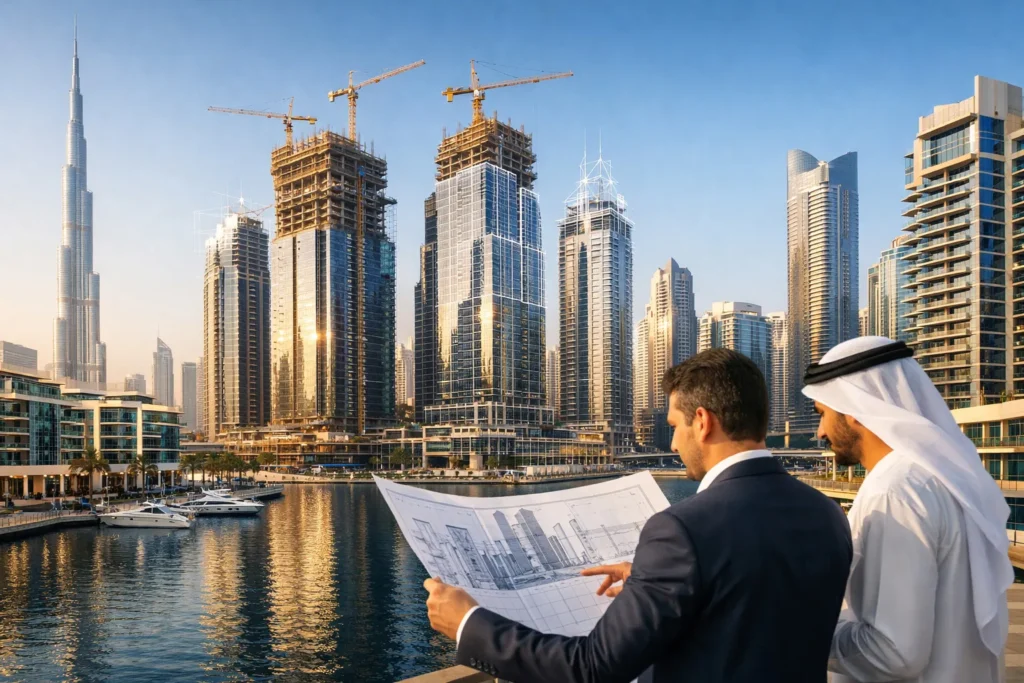

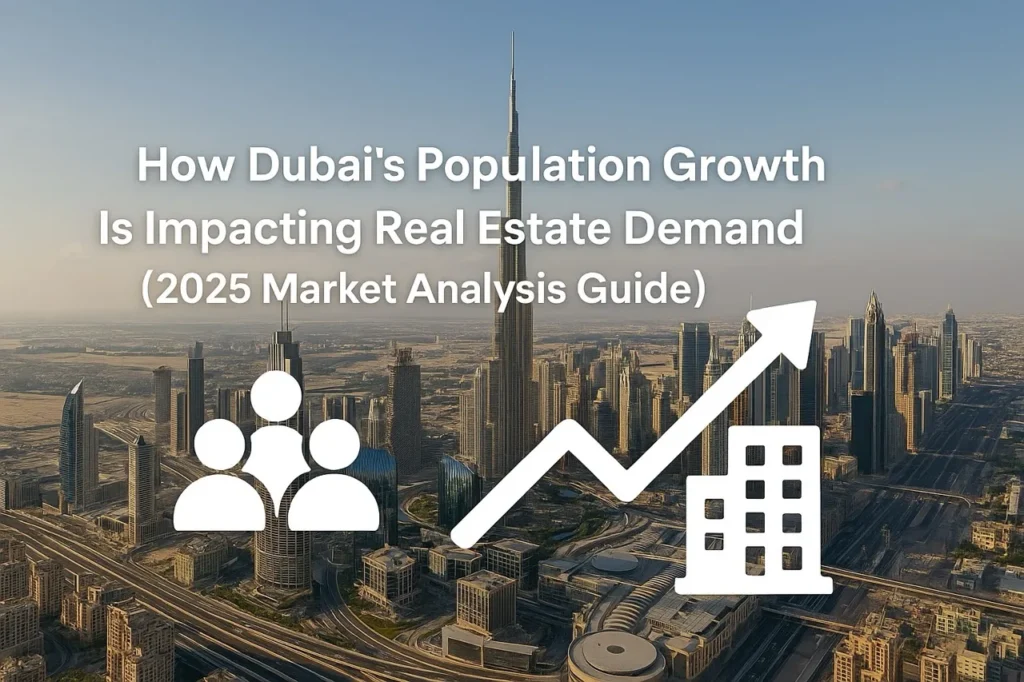
Dubai real estate demand, long-term visas, job creation, and lifestyle migration pushing real estate demand to record highs. Limited supply in villas, strong rental absorption, and new master communities are shaping prices. As the population grows, both rental and sales markets continue to tighten.
Why Population Growth Has Become Dubai’s Strongest Real Estate Signal
Dubai’s real estate market has always been shaped by ambition, infrastructure, and global connectivity. But from 2022–2025, another powerful factor emerged as the top predictor of price movement: population growth.
Dubai crossed 4 million residents much earlier than expected-and this growth is not slowing. Daily arrivals of professionals, families, entrepreneurs, and global remote workers are creating a structural demand wave that the market is still catching up with.
Today, Dubai population growth and real estate demand are so closely linked that analysts consider population trends the city’s clearest indicator of:
- Rental price direction
- Absorption speed of new projects
- Community-level demand hotspots
- Long-term appreciation potential
Let’s break the market down using data-backed logic, investor-friendly insights, and community-specific trends.
Dubai’s Population Growth Is Surpassing All Forecasts
Dubai’s growth story is unlike any other global city. The expansion is broad-based, stable, and policy-driven-not speculative.
What’s Driving This Accelerated Growth?
A. Expanding Job Market
Sectors booming with new employment:
- Technology
- Logistics & supply chain
- Finance & fintech
- Hospitality & tourism
- Real estate & infrastructure
- Aviation
Each new job feeds directly into housing demand.
B. Long-Term Visas & Immigration Reforms
Dubai is no longer perceived as a “3-year stopover.”
Key reforms include:
- 10-year Golden Visa
- 5-year Green Visa
- Skilled worker visas
- Retirement visas
- Property-linked residency
These policies convert short-term residents into long-term home seekers.
C. Corporate Relocations & Business-Friendly Laws
Global companies relocating regional HQs to Dubai means an inflow of skilled talent-most of whom rent or buy homes.
D. Quality-of-life Migration
Families are moving to Dubai for:
- Safety
- International schools
- Healthcare
- Connectivity
- Clean environment
- Predictable governance
This demographic contributes heavily to villa & townhouse demand.
The Most Unique Part of Dubai’s Growth: Diversity
Population growth is happening across:
- Single professionals
- Mid-income earners
- High-net-worth families
- Entrepreneurs
- Skilled technical workers
- Remote global employees
This means every housing segment-from affordable apartments to luxury villas-experiences simultaneous demand.
Demand is Outrunning Supply in Many Property Segments
The current supply pipeline is large, but not fast enough to balance the surge.
Where the Imbalance is Most Visible
A. Villas & Townhouses
- Severe undersupply
- Families want more space
- Master communities booked out
- Resale villa prices up significantly
Even new villa launches often sell out in minutes, showing that demand far exceeds available inventory.
B. Ready Apartments in Prime Areas
Central zones like Marina, Downtown, Business Bay, DIFC, JBR see:
- High occupancy
- Rapid rental absorption
- Off-plan units selling before completion
C. School-Proximity Communities
Areas with international schools experience intense demand from relocating families.
Developers Are Launching Faster, But Deliveries Take Time
Most major off-plan projects launching today will deliver in 2026–2028, leaving a temporary gap that keeps prices and rents elevated.
The Rental Market Feels the Pressure First (And Hardest)
When population rises quickly, the rental market is the first to tighten-and Dubai is experiencing exactly that.
Why Rents Are Rising So Sharply
- Immediate need: New residents must rent instantly.
- Limited ready stock: New communities cannot be built overnight.
- Tenant competition: Especially in popular districts and villa communities.
- Premium areas oversubscribed: Marina, Downtown, Palm, JVC, and Dubai Hills.
Apartments: The Most Active Rental Category
Strongest demand comes from:
- Young professionals
- Couples
- Remote workers
- Corporate employees
They prefer ready apartments in well-connected areas.
Villas: The Fastest Rent Increases
Because villa supply is scarce, rents in communities like:
- Dubai Hills Estate
- Arabian Ranches 1/2/3
- Mudon
- Tilal Al Ghaf
- Damac Hills
have posted some of the largest year-on-year jumps.
Why This Matters for Investors
Rising rents =
- Higher cashflow
- Higher yields
- Faster tenant placement
- Stronger long-term rental demand
This is why rental-focused investors are aggressively buying mid-market apartments and family villas.
Areas Seeing the Highest Population Inflow (2024–2026)
Population growth affects communities unevenly. The following districts are the biggest beneficiaries:
Dubai South
Key Drivers:
- Expo City
- Airport expansion
- Logistics hubs
- Affordable housing
Expected to become one of Dubai’s largest communities.
Jumeirah Village Circle (JVC)
Why it’s growing fastest:
- Central location
- Mid-market pricing
- Huge renter base
- Lots of new supplies
- Popular among expat professionals
One of the most active investment districts in Dubai.
Dubai Hills Estate
Growing because:
- Family-oriented
- Schools
- Parks
- Luxury & mid-luxury options
- Huge villa demand
Now considered the “new Emirates Living.”
Business Bay
Attracts:
- Young professionals
- Finance & tech employees
- Corporates
High-rise living with urban convenience.
Dubai Creek Harbour
Reasons:
- Waterfront lifestyle
- New master community
- Proximity to Downtown
- Growing expatriate demand
It will be a major residential hub over the next decade.
Off-Plan vs Ready: How Population Growth Affects Each Segment Differently
The population surge has created two very different demand paths:
Ready Properties: Immediate Impact
New residents need homes today, not in 2027.
Impact on ready homes:
- Prices increase faster
- Rents surge
- Low vacancy
- High resale activity
Communities with existing infrastructure see the sharpest gains.
Off-Plan Properties: Long-Term Impact
Buyers expect Dubai’s population to keep increasing for the next 10–15 years.
This drives off-plan demand because:
- Buyers lock in future value
- Payment plans are easier
- Developers offer incentives
- Future supply aligns with future population size
But a note of caution:
Oversupply risk exists in 2026–2028 if too many projects hand over at the same time in one micro-location.
Government Population Projections Are Strongly Bullish for Real Estate
Dubai’s leadership is clear: the city is preparing to host 6 million+ residents in the coming decades through the Dubai 2040 Urban Master Plan.
Key Plans Supporting the Population Boom
A. New economic clusters
- Logistic districts
- Technology hubs
- Airport expansions
B. New transit & metro expansions
Improves connectivity and unlocks new residential zones.
C. More green spaces & community centres
Enhances livability for families.
D. Multiple new master communities
Dubai South, Dubai Creek Harbour, Tilal Al Ghaf, Damac Lagoons, Meydan, etc.
Why These Projections Matter to Investors
When a city structurally plans for millions more residents, real estate is almost guaranteed long-term demand.
This gives Dubai a high-growth runway, especially in emerging communities.
What Dubai’s Population Boom Means for Investors (Practical Takeaways)
Population growth is the single clearest signal for future real estate strength.
Here’s what investors should extract:
Mid-Income Housing Is the Strongest Long-Term Bet
Communities with affordable-to-mid pricing will attract the largest inflow of new residents.
Best picks:
- JVC
- Dubai South
- Arjan
- Furjan
- Sports City
- IMPZ
- Meydan (mid-market clusters)
Family-Oriented Villa Communities Will Remain Supply-Constrained
Villa supply is limited and costly to build.
Top villa picks:
- Dubai Hills Estate
- Arabian Ranches
- Damac Hills
- Tilal Al Ghaf
- Mudon
Rental Market Will Stay Strong Until 2026–2027
Because most major off-plan projects deliver later.
Investors focused on yield should capitalize on this cycle.
Watch Supply Cycles Carefully
Oversupply is possible in specific micro-markets.
Always check:
- Delivery year
- Project clustering
- Community saturation levels
Long-Term Appreciation Is Strong for Master-Planned Areas
As the population grows, areas with schools, malls, hospitals, parks, and infrastructure outperform.
Conclusion: Dubai’s Population Growth Is Reshaping the Real Estate Market
Dubai’s rapid and diverse population growth isn’t a short-term spike-it’s a structural transformation. As more people move into the city for work, lifestyle, and long-term residency, the real estate market responds with stronger rental performance, tighter ready inventory, and continuously rising demand across both affordable and premium segments.
For investors, population growth is the clearest, most reliable indicator of where opportunities will emerge next.
Dubai isn’t just a growing city-it’s a scaling global hub, and real estate remains one of the biggest beneficiaries of its rising population curve.
FAQs
How is Dubai’s rapid population growth affecting real estate prices in 2025?
Dubai’s rising population is pushing both rental and sales prices upward, especially in villa communities and centrally located apartment districts. High inflow of residents means stronger demand than available ready supply, creating sustained price pressure.
Which Dubai areas are seeing the biggest population-driven housing demand?
JVC, Dubai Hills Estate, Business Bay, Dubai South, Arjan, and Dubai Creek Harbour are currently experiencing the highest influx of new residents, leading to faster rental absorption and rising property values.
Will rents in Dubai continue to increase as the population grows?
Yes. With more residents arriving every month and new supply scheduled mostly for 2026–2028, rental prices are expected to remain elevated, especially in mid-income apartment communities and family villa districts.
Does Dubai’s population growth impact off-plan or ready properties more?
Ready properties feel the impact first because new residents need immediate housing. Off-plan benefits from long-term demand projections, with buyers betting on even higher population levels by handover.
Are villas becoming more expensive due to population growth?
Absolutely. Family migration is a major driver of Dubai’s population increase, and villas are undersupplied. This makes villa prices and rents rise faster than apartments in many master communities.
Is Dubai’s population expected to grow further under the 2040 Urban Plan?
Yes. Dubai aims to accommodate 6 million+ residents, supported by new economic zones, transit systems, and master-planned communities. This long-term growth ensures ongoing real estate demand.
Can Dubai face housing oversupply despite a growing population?
Oversupply risk exists only in certain micro-markets with heavy off-plan clustering. Overall, city-wide demand remains strong because population growth is outpacing near-term supply.
Is it better to invest in mid-income or luxury properties during population growth phases?
Mid-income apartments and townhouses typically benefit the most because they match the demographic entering Dubai-professionals, families, and long-term residents. Luxury segments rise too, but depend more on global wealth trends.
How does population growth affect rental yields for investors?
Mid-income apartments and townhouses typically benefit the most because they match the demographic entering Dubai-professionals, families, and long-term residents. Luxury segments rise too, but depend more on global wealth trends.
Which future Dubai communities will benefit most as the population expands?
Dubai South, Meydan, Dubai Creek Harbour, Tilal Al Ghaf, Damac Lagoons, and Arjan are positioned to gain the most due to new infrastructure, schools, transport links, and large-scale master planning.